Saturday, April 6, 2013

SCS 2013 & Local Competitions

Source: http://scsnationals.org
Today I read Twitter with much envy as everyone attending the Sport Climbing Series Finals gets hyped.  Watch it tonight live at 7:30 PM Central on Louder Than 11.  Check out Climbing Narc for a list of the finalists and highlights.

Climbers like Daniel Wood and Carlo Traversi have been busy since ABS 14 climbing hard outdoor boulder routes, and they'll be bringing that V15 power to tonight's finals.  Also among the climbers is Sasha DiGiulian, who we haven't seen in a comp for awhile.  She's been training hard though, as recently she crushed two 5.14's in a day at those tough crags in Spain.  It will be truly great to see their outdoor power undergo the measurement of indoor sequences.  

In addition to today's SCS nationals, there are competitions going on locally.  There was a comp today at Climb On in Homewood, IL, as well as others coming up this month in our region:

-April 20th Vertical Endeavors Minneapolis in Minnesota is putting on a fun inclusive Jug or Not comp.
-April 26th & 27th Climb Iowa is having their You Only Lead Once comp.
-April 28th Boulder Climbing Gym in Madison, WI is have their Rock Candy Land sport climbing comp.

If you're around you should check out one of these comps. Regardless, though, watch tonight stream of SCS 2013 for some good, hard climbing.

Thursday, March 28, 2013

Pully Problems.

Someone recently told me that the fastest way to get better at climbing is to not get injured. Finger injuries are the most common injury in rock climbing. Let’s face it: the ability to land a quarter-pad crimp on a 45 is not inherent within human physiology. For a lot of climbers, finger injuries become an annual (annular?!) thing. Lately for me it’s been more like a bi-monthly thing (RIP: Some Part of My Pinky). These injuries can mess up your training schedule and, in serious cases, even go as far as permanently wrecking your ability to stick tough holds. I’ve been getting pretty tired of these pesky twinges and strains. So, in lieu of my recent run-ins with painful finger problems, I’ve started looking further into fingers, injuries, and treatment.

When it comes down to it, it’s all about your tendons and the muscles that support them. Climbing puts a lot of stress on your tendons, and most injuries come from overusing them. I’m sure we’ve heard this word “tendons” nearly a thousand times at the gym. But, do you really know what’s going on underneath the skin when you hear that snap-crackle-pop?


Painful Tendoncies


The most frequent type of finger injury manifests as a damaged flexor tendon pulley, usually as a result of supporting your bodyweight with just a finger or two. Pulleys are fibrous tissues that support your tendons by forming tunnels for them to go through. The tendons are a connective tissue, which extend and contract by way of the flexor mucles deep in your forearm. Tendons and pulleys develop at a much different rate than, say, the muscles we use for climbing. It can take up to 100 days or more for these parts of your finger to heal fully. One of the things that gives climbing its steep learning curve is the difficulty of developing these finger tendons.

Of course not all pulley pains are created equally, and so that sudden pain can mean different things. An instance of injury can vary between three grades of severity:


Grade I – Sprain of your finger ligaments (collateral ligaments) in pulley, pain manifests in the pulley when squeezing or climbing.

Grade II – Partial rupture of the pulley tendon. Pain locally at the pulley, pain when squeezing or climbing, also pain is possible when extending your finger.

Grade III – Complete rupture of the pulley causing bowstringing of the tendon (“bowstringing” is the effect created when your tendon is no longer being held against the bone). Symptoms of such a rupture include pain locally at the pulley (usually sharp), a “pop” or “crack” may be heard/felt, swelling and bruising, pain when squeezing or climbing, pain when extending your finger, pain with resisted flexion of the finger.


Three Phases to Healthy Hands


Phase 1: Keep Calm and Leave the Gym - If you do feel that sharp twinge or crack in your finger, you should immediately stop climbing and any other activity that puts stress on the injured finger. This means no crimping your coffee cup, no aggressive tapping on the shoulder, and most importantly - no climbing. Yes, this first step toward recovery, not climbing, is the toughest yet the most important. A couple weeks ago I got a grade one strain instantly upon my arrival to the gym. It was a tough battle of will especially with my climbing buddy encouraging me to continue. The upside is that I still had time on my CTA transfer, so I excused myself before the temptation to climb became too overwhelming.

After you’ve ceased all finger-stressing activities, go to a doctor and see if there is any bowstringing on the tendon. Even if you think you’re in the clear, a doctor will at least verify that you have nothing to worry about – which can help keep your cool. Give yourself at least one week before trying any finger-heavy activity.


Phase 2: On the Mend - When the pain and swelling is gone which, depending of the grade of the injury may take one to four weeks, begin rehabilitating the finger. Go pick up some TheraPutty or a stress ball and begin to slowly exercise the finger muscle. By taking these exercises slowly and combing them with light massages and stretches, you can ensure a proper healing process to prevent future mega-ouchies. Alternating heat and cold and taking an NSAID like Aleve can help reduce inflammation and improve the blood flow necessary to begin healing. Continue the rehab for about twice as long as the resting period (two to eight weeks) before returning, and with the highest caution, to climbing. 


Phase 3: Slow ‘n Steady Sends the Route - When you do begin climbing again, stick to easy routes with big holds and good footholds. That is to say, don’t jump right back on the route that blew your finger out in the first place. I foolishly tried this once, and now look at me – I’ve had so many finger problems I could write an article on them. Keep your sessions short, stay away from overhangs, and remember to tape up that finger. Studies have actually shown that the H-Tape Technique is a good prevention method for previously injured fingers. Check out this video to learn how to H-Tape.


The H-Tape Technique supports the damaged pulley in bearing the stress of the tendon.

Once you’ve gotten back into the groove of things and easier climbing yields no pain, you may return to full-force crushing. Continue taping (it will also serve a little reminder to go easy on the finger) and avoid tiny crimps and finger pockets for a while longer, since, as mentioned earlier, tendon healing can take 100 days or more.


Prevention

You can avoid pulley injuries by climbing smart and taking precautions. Change your training and follow some simple rules to stay injury free:

            • Always warm-up. This one took me awhile to figure out.
            • Vary the types of hold you climb on – slopers need love, too.
            • Don’t always use finger-heavy training tools (hang board, campus routes).
            • Utilize good technique to minimize finger stress.
            • If something feels weird, don’t try it.

Adding foods to your diet that contain omega-3 fatty acids can reduce tendon inflammation. Eating foods like salmon, tuna, flax seed, or the super trendy chia seed are good for every climber’s diet.

Remember to always take the advice of your doctor. If he/she should say anything that conflicts with what you see written here, take his/her word over mine. Be careful out there.

Sources & Further Reading:

Finger Pulley Injuries
ClimbingInjuries.com Section on Fingers and Pulleys
Rock Climbing - Reaching New Heights
Wikipedia: Climber's Finger
Tendon Health & Nutrition

Tuesday, March 5, 2013

Comp Day in the Windy City

This past Saturday, March 2nd, I had the pleasure of taking a trip out to Vertical Endeavors in Warrenville, IL to cover the twelfth incarnation of their Masters of Plastic comp, "No Holds Barred". Joined by fellow Chicago Climber, Colin Caulfield, we ventured from our cozy urban dwellings out to the suburbs, where the horizons are open and the walls stretch up past the anchors.

Shall We Set the Stage?
We entered the Vertical Endeavors amidst competitors and spectators alike and quickly noted, this was the single largest collection of climbers I had ever seen. VE had set the cap on climbers at 175 and hit that mark several days before the comp. If I had thought of spontaneously signing up at the last minute, my hopes had been dashed. Nevertheless, the gym as packed not only with the climbers themselves but also parents, friends, and folks who just wanted to see a good day of climbing.


The gathering storm.
Soon after we arrived the competition was set to begin. Everyone gathered in the main crag to hear the rules:
  • 4 hours to complete 5 top roped routes, 1 boulder problem
  • 2 attempts per problem
  • No takes
  • Nats are marked for hands
  • All nats for feet
  • If a volume is marked, all the holds are on
  • Max points for top out
  • Less for high point
  • Must demonstrate control of final hold or top out


And with that, climb on.

Climbing Frenzy
Everyone dashed to scope out their routes. As with most comps, there were divisions for every grade of climber and VE did a great job of making interesting routes in each. It wasn't so much that I just wanted to watch the climbers on the hardest problems but rather I wanted to see climbers on the interesting features of the gym. However you feel about "natural" rock walls indoors, VE definitely took advantage of the features of their walls. I saw climbers of all skill levels struggling with dihedrals, aretes, overhangs, and several multi-faced routes.


The open division even had one lead route that slowly crawled up the wall and onto the ceiling (left.) Photo credit Colin Caulfield.

The boulder problems seemed to present the hardest problem a division could offer, with point values marked at each hold. They were typically scrunching-type problems requiring the climber to master their balance and body positioning before they were able to reach the next move. In some cases there weren't even any holds on the wall, just boxed out nats for competitors to divine a way of gripping.


The stem was important for careful thought and chess-like movement.
Divisions of Labor
One of my favorite problems of the day was in the back corner of the room typically reserved for auto-belays. Pictured at left in white, this route wasn't the most physically demanding of the comp but it was a head-scratcher. The climber went up from face to face pretty smoothly until the last third which started with a big reach to the left wall, then some careful maneuvering up those few holds, until he had to figure out how to use his powerful stem to get from the multitude of holds over to the lone finish hold on the right face.

After changing his beta, this climber saved his stem for after his left foot was higher, then shifted to his right leg and brought his hands over for the send.

I spent a great deal of time watching folks tackle another multi-faced route, pictured in white below. There seemed to be two main plans of attack. The first was to get high enough on the right wall so the climber could move easily to the left face. Even this approach required calculated use of feet on the underside, however. This woman here made it another move or two farther before dropping. The second plan took full advantage of the overhanging feature. If this climber approached this section with her hand positions flipped she could lean back, hanging underneath, before performing a saving throw up to the next hand. It did seem that the first sequence of beta yielded better results as the climber seemed to have more stamina left after the crucial crux.
Chicago Climber, Colin Caulfield gets the beta on some digital photos.

Finalists
After all was left on the field, there stood the victors --those with just that much extra to throw at the wall. Of the total 175 climbers, only 4 or 5 in each division were able to place in the finals. VE was nice enough to post the results of the comp:

Men’s Advanced Finals
Photo credit Colin Caulfield.
1st – Joe Mastey
2nd – Zach Joseph
3rd – Jacob Schnake
4th – Alec Hein
Women’s Advanced Finals
1st – Melinda Eshelman
2nd – Meghan Stukel
3rd – Susan Okasinski
4th – Katie Kelly
5th – Irene Yu
Men’s Open Finals
1st – Kevin LaForge
2nd – Matt Wrodarczyk
3rd – Frank Wu
4th – Doug Aburano
Women’s Open Finals
1st – Karolina Nowak
2nd – Katie Erickson
3rd – Amy Verrando
4th – Karen Gilbert

For a full list of the standings in the semis and results from other divisions, check out the full comp results here.

A Matter of Distance
One of the coolest things about this comp was how it drew in climbers from gyms all across the Chicagoland area. There were teams of climbers from that selfsame Vertical Endeavors, a group of little Arya Starks from North Wall in Crystal Lake, and of course folks from our home gym of Hidden Peak. This was an opportunity for our climbing community to coalesce and show each other what we're made of. Chicago is an interesting scene--most of our gyms are out in the suburbs, where there's actually space to climb--that lends itself to a more disparate community. I, for one, have only occasionally been able to make it out to the suburbs for a day of climbing and believe me, it took a bit of planning.

This is of course in contrast to neighboring Midwestern cities, namely the Twin Cities and St. Louis, where the majority of climbing is centered around one or two gyms. St. Paul and Minneapolis each have one VE, and St. Louis has the relatively new Climb So Ill and Upper Limits. These gyms are in large part in the industrial areas of their respective cities, where there is space enough for a climbing facility. The market for real estate in Chicago is even tougher, and more difficult to turn a profit.

But did I mention that we're resilient climbers? The fact that we're willing to travel from the four corners of the state impresses me to no end. We may not have a main hub of climbing like other cities, but the spirit of climbing is undoubtedly strong in Chicago. Thanks for sticking around for my pontification, I'll see you at the crag.


-Benjamin Gappa
Chicago Climber

About me: My love of climbing extends back only about 8 months when I took my first trip to Red River Gorge. Since then, hardly a week has gone by that I haven't been Hidden Peak at least 3 times crushing V0s and V1s, though V2s have been sending me death threats like every other day. I have a fear of heights but sport climbing is my meat and potatoes. Other interests: meat and potatoes. While working as a traveling archaeologist I'm afforded the opportunity to check out gyms and crags all over the country.

Snow Day

A snow storm took our visit to the gym hostage today.  We didn't let the day go to waste though, because we did some of our antagonists and core conditioning.  As I paused between planks, though, I thought about the cold.  

People's perception of what is cold is relative.  I have a co-worker who never wears a winter coat, and he's a pretty skinny guy too.  I, however, always bundle up too much for the weather.  Even when it was 104 degrees in the Red River Gorge last Summer, I had a hoodie tucked in my day-pack - just in case (it's my inner-Minnesotan).  And, to think that people enjoy climbing in the cold astonishes me.  If only I were so bold.  Strangely, I've gotten fairly self-aware of my need for warmth, and have actually gone as far as challenging myself to wear fewer layers outdoors.  Why? Because I read both parts of the article The Eiger Contradiction, of course.  

"Something defying all description lies locked in that hushed atmphitheater.  Does that concave face
embrace the dimensions of death itself; of the negation of everything?" - Kurt Diemberger,1959
 (Alpinist 41, 47) [Image source: wikimediafoundation.org]


The article appeared in the last two issues of Alpinist magazine (40 & 41), and outlines the history of ascents made on the Eiger.  Everyone knows that you can't think about the Eiger without also thinking about cold, frostbite, and death.  I mean, talk about cold being relative.  Alpinists who were first ascending the mountain didn't have North Face thermal layers with super insulation or electric socks.  Some of these guys had to loosen knots with their teeth as they hung suspended in the middle of a running-belay with an abyss below because their partners died and their hands were too frostbitten to use. These climbers could probably walk around Chicago on a windy February day with a tank top on.


Ludwig Vörg, one of the first to climb the "unclimbable" North Face, takes a seat on the Eiger 
and adjusts his stokings (1937). [Image source: alpentoppen.be]

So, let the stories of these alpinists be our battle cry.  Let's not allow the snow or the cold take our day hostage.  Do some mind-over-matter, Chicago, and get outside - but don't forget to break early when you're driving.

-Matt


Monday, February 25, 2013

Four Great Moments in ABS 14


Our bouldering gym has been vibrating these last couple days from all of the hype at the American Bouldering Series 14.  I actually think it was partly responsible for getting me psyched enough to send two of my projects.  But like everyone was saying on Twitter: The ABS 14 stream was like climbing’s very own Super Bowl.  Despite the lack of high-budget commercials, I know our apartment wasn't the only one filling up with people eager to see D-Wood defend his title against the dyno’ing power of Vasya Vorotnikov and the indoor-headband swag of Ian Dory.  And before it fades into the backdrop of American climbing history, let’s take a moment to look at some of what we at Chicago Climber think are the highlights from ABS 14.

Women’s Problem #2: The Pyramidal Puzzle from the 31st Century.
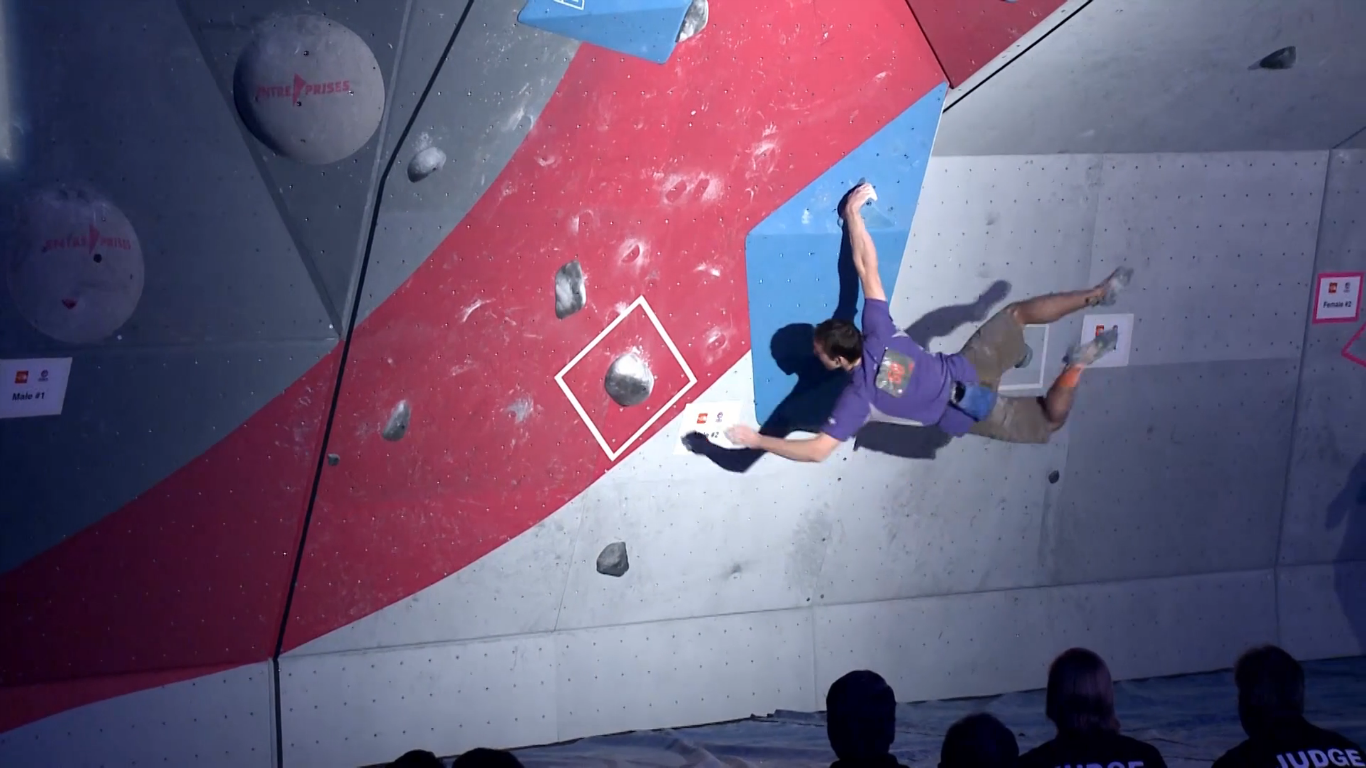
Not only was the beta lookin’ gnar on this gymnastic challenge, but the route itself was quite a site (see image below).  The problem forced competitors into iffy hand/foot matches as they twirled their bodies up a dramatic overhang all using holds mounted on slopey pyramids.  I wasn’t sure if this problem was inspired by iRobot or Tron.  The first thing out of my mouth when I saw the first attempt of W2 was “Damn! That problem looks straight outta the future”.  I bet Sierra Blair-Coyle had the same thought, but didn’t Tweet about it because her Twittered crashed due to her persistent and thorough coverage of the event (I should just dream on...).  In the end, I’d say this route came out as one of the competitions most creative and entertaining problems – especially when Puccio flashed it.


Alex Johnson cuts her feet and faces the crowd as she figures out Problem #2.[Image source: absnationals.org]

Vasya Vorotnikov’s Dyno on Problem #2
During moments like this one, I always wonder what the route setter’s reaction is to someone skipping four of your meticulously placed holds with a mighty one-handed dyno to a slope intended for feet (pictured below).  We were channeling Vorotnikov a serious high-five for not just his creativity, but for knowing how get a crowd riled up.  This is the kind of this that you want to see in a competition.  It really plays into that gladiatorial arena vibe that gets me all amped at comps.


Vorotnikov sticks his dyno on Problem #2. [Image source: absnationals.org]
Isabelle Faus Represents Chicago
Chicago Climber cannot forget to give Isabelle Faus a BIG SHOUT OUT for reppin’ the windy City and all the urban climbers.  She climbed at our local bouldering gym, Hidden Peak, for about 8 years. Way 2 crush your way to the top Faus!

The three female winners: (from left to right) Isabelle Faus, Alex Puccio, and  Andrea Szekely.
[Image source: absnationals.org]

Live Online Stream: Ushering in the Age of Climbing
The ABS 14 stream unified climbers around the country in our own aired event.  Sure we all get psyched to go to our own local competitions, but when have climbers in the country gotten a chance to watch the biggest indoor bouldering event live?

The Twitter feed was blowing up.  The ABS 14 chat room was blowing up.  I would really like to get ahold of just how many people streamed the ABS 14 competition, because I think the people over at the Olympics would perk their ears hearing how many people want to see climbing.  In case you haven’t heard, climbing is in the running for possibly being in the 2020 Olympics.  It is aired events like this that get us that spot – and ultimately the recognition that climbing deserves!  I think I speak for everyone when I say: let’s keep this hype growing.

What were your favorites moments in ABS 14?  Tell us below.

Highlights and pictures have been released.  For more information on ABS 14 goto:
www.absnationals.org/
www.usaclimbing.org/
spotsettingblog.wordpress.com/category/comps/
www.climbingnarc.com/
All photos were taken from the highlight reels at the ABS website


-Matt
Chicago Climber


About me: I’ve been climbing for 5 years both indoors and outdoors.  Since I’ve lived in Midwestern cities my whole life, most of my climbing has been at indoors gyms while outdoor trips are scattered throughout my year. I like long crimpy sequences, matching on slopers, and “blacking out” while leading.  I currently climb at Hidden Peak a few times a week, and plan on visiting the Red again in April for my birthday.

Look for my posts next week!

Saturday, February 23, 2013

Greetings

Hello to friends and climbers alike, and welcome to Chicago Climber.

I am Benjamin Gappa and I’ll be one of the writers here. I’m a relative newcomer to the sport but, as many folks have experienced, climbing quickly entered my cells and restructured my DNA. I’ll give more lip service to that later on but I thought I’d write this post so all you cats can get a feel for what it is we want to do here:

We’re here to talk about the growing rock climbing community in and around the urban center of Chicago. Traditionally, urban climbing has been a bit of an idiosyncrasy. How can you climb if you live in a city? Well, gyms are popping up everywhere and interest in the sport has never been higher. Even so, real estate in Chicago is the beast it’s always been and most climbing endeavors happen outside city limits or in fitness centers not as dedicated to climbing as we’d like them to be. Still, climbers are resilient and resourceful people, not letting a little thing like access stop us. If anything this makes Chicago climbers a diverse group, coming from every-which-where in the city.

This is the energy we’re trying to harness. We’ll be writing about everything from gyms in the area to destination climbs in the Midwest. Personally, I’m excited to be able to track my progress as we venture through blogland and share my experiences developing as a climber. All of us here at Chicago Climber want to bid you a tender and warm welcome to our life of climbing.

Bg